Sold to the people
who pay for PTSD.
Institutional buyers positioned to administer inside the window — and carrying the long-term cost of not doing so.
Psychiatric
Clinics
Urgent psychiatric networks already seeing post-trauma patients within days of the event — the fastest route to real-world evidence and repeat volume.
EMS & Trauma
Centers
The first clinicians to reach the patient, and the only people on earth positioned to administer inside the golden hours.
Defense &
Government
Stockpile procurement for forces that both generate and absorb trauma at scale — and already fund preventive readiness.
Annual cost of one untreated PTSD patient, against a single $300 intervention.
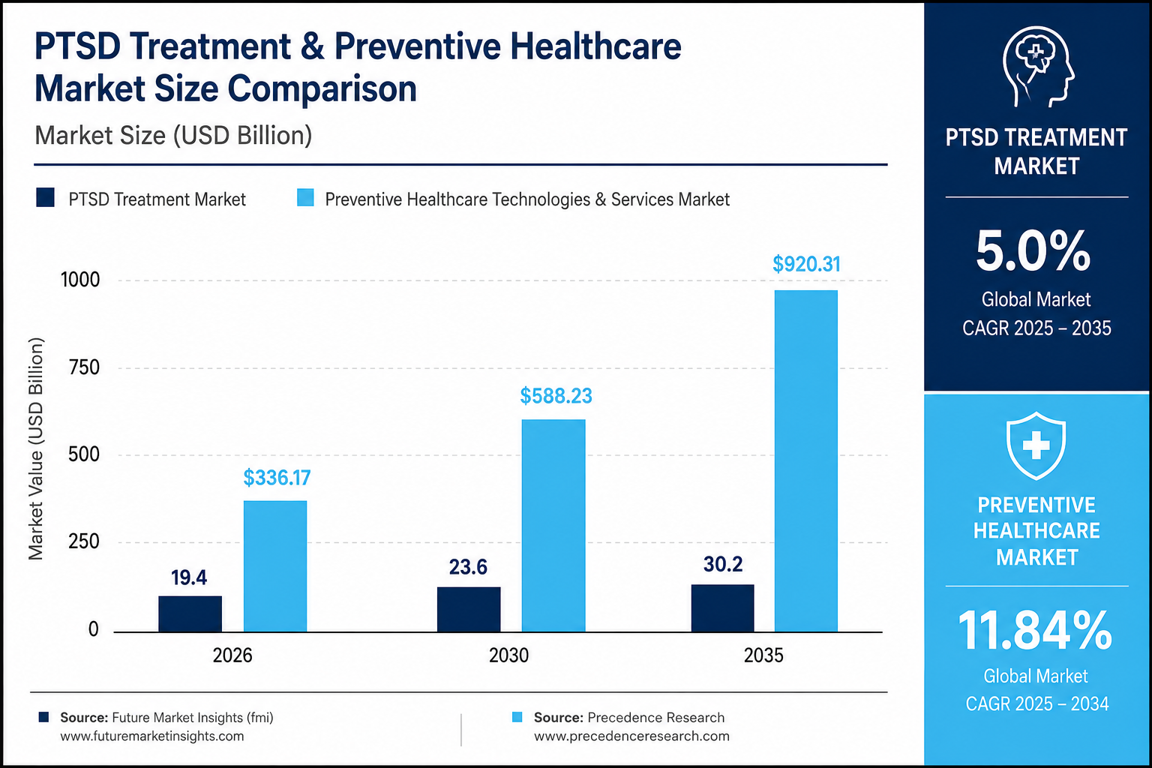
Market sizing per Future Market Insights (PTSD treatment market) and Precedence Research (preventive healthcare technologies & services market).
Innovative science.
Old-fashioned business model.
The mechanism is new. The commercial structure is not. Take a known compound, pair it with a device that puts it where it has never been able to go, and own the combination. It has produced multi-billion-dollar franchises three times over.
Epinephrine — known since 1901
Auto-injector for untrained hands
Naloxone — approved 1971
Nasal spray for bystander rescue
Esketamine — a known anaesthetic
Metered nasal device, in-clinic protocol
Revenue and exit figures are publicly reported outcomes, shown as commercial precedent for the drug-device repurposing model — not as a forecast of TraumaShield performance.
Treating the fire,
not the smoke.
Reactive care compounds for decades. Prevention resolves in a single administration — and the cost curves are not close.
High cost: Years of therapy, SSRIs, and lost productivity.
Low recovery: Treating the "smoke" after the fire has settled.
Chronic: Lifelong struggle with PTSD symptoms.
Low cost: Single-use, immediate intervention.
High resilience: Treating the "fire" during the Golden Hour.
Preventative: Blocks fear memory consolidation entirely.
$19,600/yr chronic PTSD care cost vs. $300 one-time TraumaShield intervention.
"From concept to clinical. Every milestone de-risks your investment."
Next milestone: Generate real-world evidence with DDR&D, hospitals, and EMS — toward FDA approval.
Path to commercialization
Five years from Phase 2 to standard of care.
What has to
be true.
This is a hard problem and a long road. We would rather you hear the risks from us than find them yourselves — and we have a plan for each one.
Human efficacy has been shown in an independent surgical-trauma study, not yet in our own controlled trial.
Protocol complete, PI and pilot centres secured, and the effect reproduced preclinically across SEFL models before we spend a dollar of trial budget.
A combination product has to survive a real trauma scene — no power, no training, no second chance.
Deliberately simple architecture — four passive components, no electronics — led by an advisor with deep medical-device development experience.
Drug-plus-device review is more complex than either alone, and prevention indications are new ground for psychiatry.
505(b)(2) pathway confirmed on an already-approved agent, pre-IND package prepared, and a former FDA medical officer on the board.
Getting into every ambulance and IFAK means changing standard of care, which takes institutional will.
A 37–86× cost argument aimed directly at the budget holder, plus defence and psychiatric-network partnerships already in motion.
It is a hard challenge and a hard road ahead of us. We are going to do it anyway — and you can do it with us.
What this
round buys.
Four outcomes. Each one moves TraumaShield from a validated hypothesis to a company positioned for pivotal trials.
Executed to primary endpoint — the data package that unlocks everything after it.
Engineering completed to a unit that can be deployed in real clinical settings, not a prototype.
Regulatory groundwork and clinical infrastructure in place to move straight into the pivotal stage.
Defence, EMS and psychiatric networks converted from conversations into signed programmes.
Access the full scientific and commercial package.
TraumaShield One-Pager
A concise overview of the problem, our field-deployed PTSD prevention device, the $3.0B market opportunity, and our clinical validation.
View PDFFull Pitch Deck 2026
Comprehensive deep-dive into the neurobiology, regulatory pathway (505(b)(2)), IP strategy, and our Phase 2 clinical trial roadmap.
View PDF