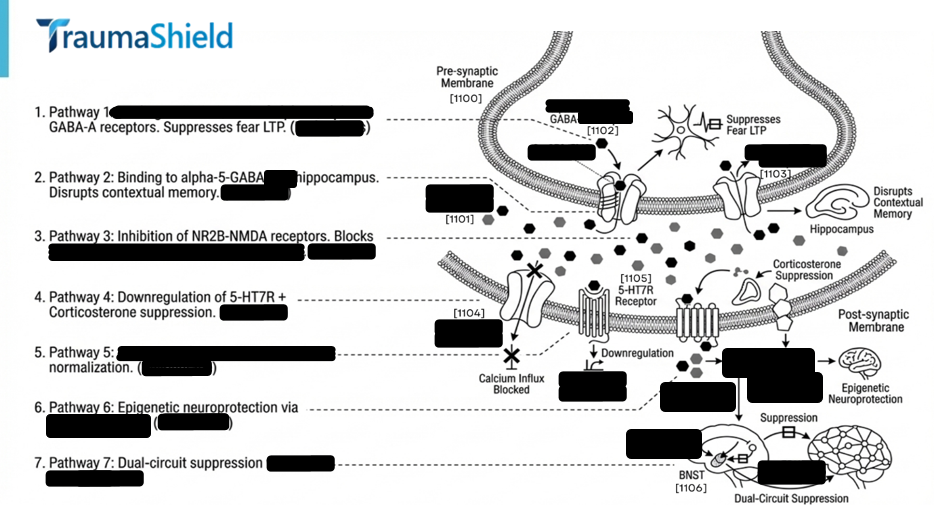
Mechanism of action
Memories are consolidated — not formed — in the hours after trauma. TraumaShield acts on four pathways during that window. Select a pathway to load its model.
Suppress fear learning responses (by reducing the hyper activity in the Amygdala).
Enhances healthy contextual memory (by enhancing hippocampal neuroplasticity).
Enhance GABAergic inhibitory transmission.
View model →Suppress excitatory NMDA receptor activity.
View model →Modulate neuroprotective pathways to prevent long-term damage.
View model →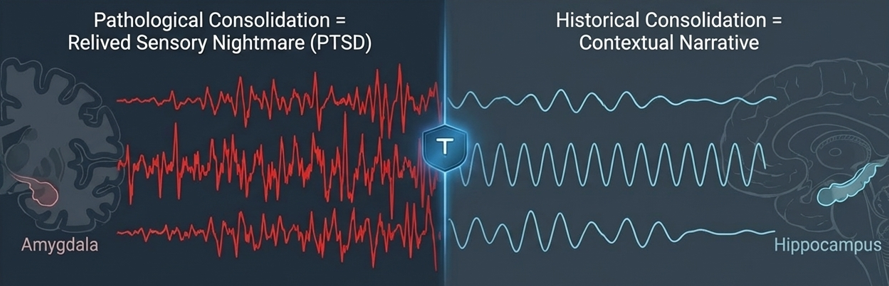
Real-time drug‑device intervention for post‑trauma disorder prevention
Administered during the post-trauma “golden hours” to support healthy memory consolidation.
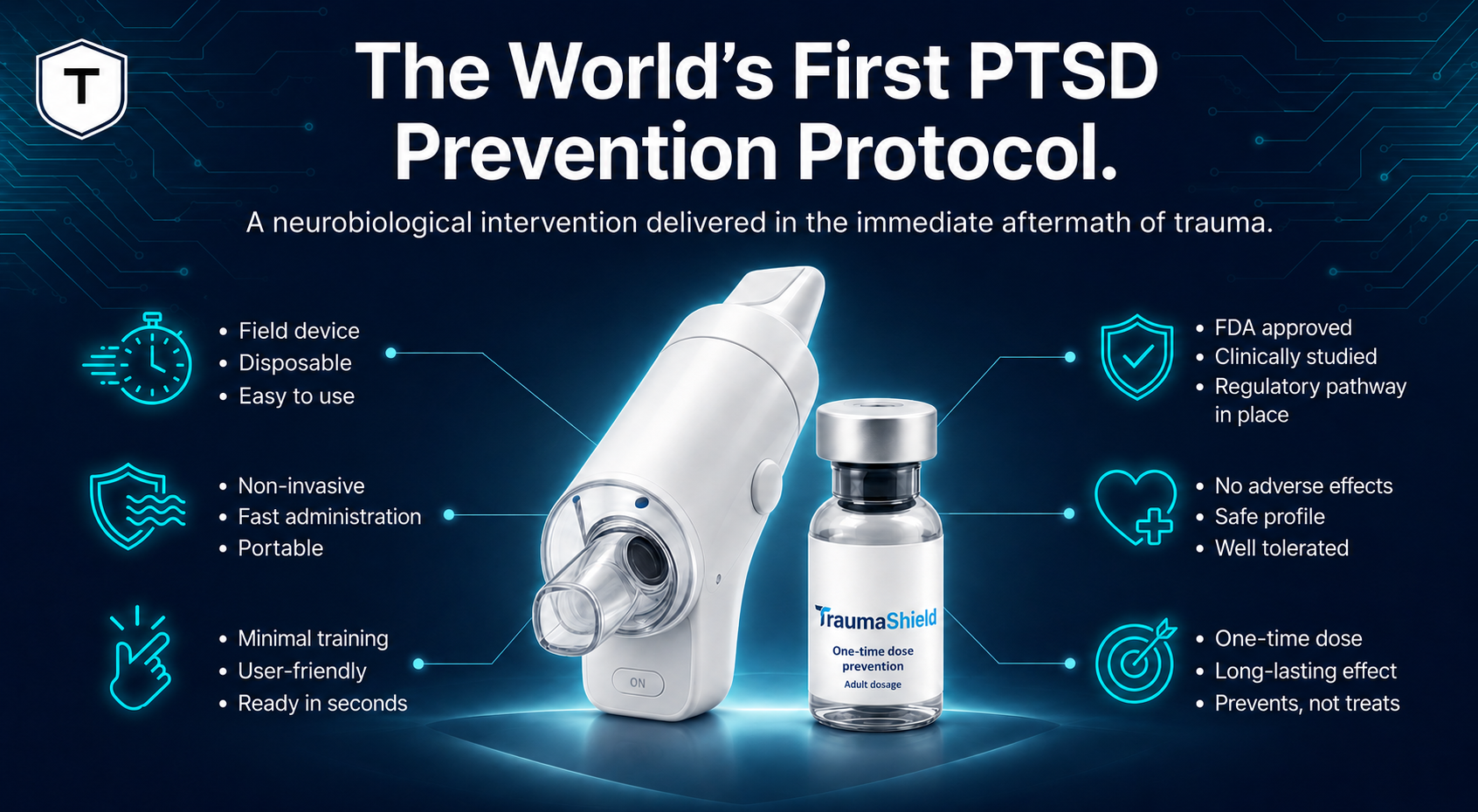
An FDA-approved compound that helps the patient perceive the event as natural rather than traumatic, allowing it to be remembered as a past, safe experience instead of an ongoing nightmare.
Delivered through a dedicated, disposable, and easy-to-use inhalation device.
47% reduction in PTSD incidence.
Validated. Peer-reviewed. Reproducible.
The neuroscientific mechanism explaining why the 0-6 hour window is the only viable prevention point. Memories are consolidated — not formed — in this window, making pharmacological intervention uniquely effective.
Existing safety profile eliminates Phase 1 risk entirely. The repurposed agent has a well-characterized pharmacokinetic and safety profile from prior clinical use.
Backed by independent peer-reviewed studies. 47% reduction confirmed in human surgical trauma data. Reproducible across preclinical SEFL animal models.
"Backed by independent clinical validation and a full scientific package assembled by world-leading experts in psychiatry and neuroscience."
Protected, fast,
field-ready.
A method-of-use patent, an accelerated regulatory pathway, and a form factor built for the field — three defences that compound.
Exclusive rights secured for the second medical use and combination device architecture.
Streamlined FDA pathway confirmed, leveraging existing safety data to accelerate time-to-market.
Fits standard IFAK kits. Zero training required. Instant activation for immediate post-trauma care.